VoC data and AI: governance before models
Customer intelligence programs usually fail because nobody owned the corpus, consent, and escalation path, not because the wrong model was chosen.
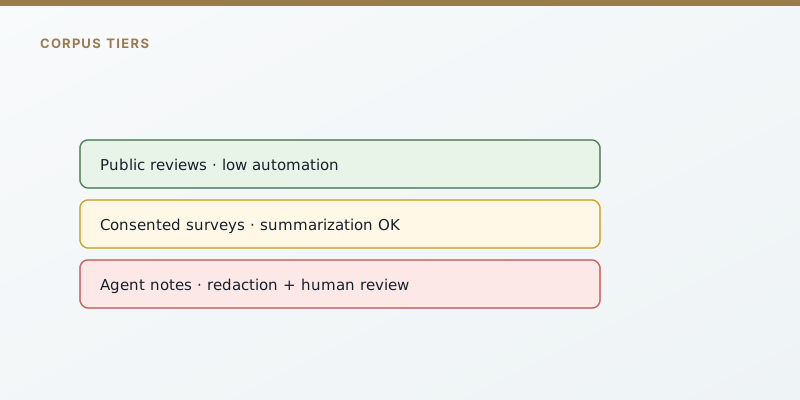
Model-selection meetings are seductive. Most production crises I see on the VoC side start in the data pipeline: which feedback is eligible for automation, which sources have consent, who intervenes when a wrong summary reaches an agent. Until those questions have owners, even a strong model is a liability.
At Pivony we treat governance as mandatory rules in the pipeline, not a policy PDF. CX owns what may enter automation; technology makes it enforceable. If you are running a 90-day pilot, tiering and escalation should be live before customer-facing output.
Tier the corpus before connectors go live
| Source | Typical tier | Automation |
|---|---|---|
| Public reviews | Low sensitivity | Summarization with citation |
| Consented surveys | Medium | Rubrics + human spot-check |
| Agent free-text notes | High | Redaction, retrieve-only, or off |
| Executive escalations | Critical | Human path only |
Escalation must be faster than the AI path
Automation is credible when the fallback is visible and fast. Design escalation with CX operations: who gets paged, SLA, audit logs. Test the path before model selection dominates the agenda.
If a policy line has no technical control, it is aspirational, not governance.
Bind policy to controls
Each rule needs a technical counterpart: access groups, retention jobs, redaction, block lists. NIST AI RMF is a useful map for mapping CX rules to measurable controls. Production RAG inherits the same tiers.
Frequently asked questions
Who should approve corpus scope?
Not IT or data alone. CX brings which sources touch customer-facing work, legal brings consent and retention rules, and data owners bring freshness and quality. All three sign off before connectors go live.
When can you automate on agent notes?
When tiering is explicit, consent and redaction rules are written, and the escalation path for wrong output has been tested in production-like conditions. Skipping those steps pushes risk onto customer teams.
How does VoC governance connect to RAG?
Production retrieval inherits the same tiers and access rules. A source CX marked “never automate” must stay mandatory in the retrieval layer, not only in the VoC playbook.
For, CTO and technology leaders
Implement tiering in the pipeline. CX “never automate” sources must be mandatory in code.
Paired perspective: RAG in production: what the CTO office should own vs delegateFurther reading
- Gartner: AI value as top barrier, 49% cite value demonstration
- NIST AI Risk Management Framework, Governance structure
- OECD AI principles, Responsible deployment context
- Schema.org Dataset, Metadata and provenance patterns
Running a program on this topic? Describe your context, technology, experience, or both.
Discuss an engagement